


Types of Court Representation in the UK
Navigating the UK legal system can be overwhelming, especially when figuring out what type of legal representation is best suited to your situation.
Whether you’re defending yourself in criminal proceedings, filing a civil claim, or seeking resolution for a family dispute, choosing the right legal representation is crucial.
In this blog, Harry Suleman Solicitors will explore the different types of legal representation available in the UK and the factors you should consider when making your choice.
1. Duty Solicitors and Public Defenders
For those facing criminal charges, duty solicitors and public defenders are often the first point of legal help.
Duty Solicitors
Duty solicitors are private practitioners who are funded through legal aid. They are available at police stations and magistrates’ courts to assist individuals who have been arrested, charged and do not have their own solicitor to represent them.
Their services are free of charge, regardless of your financial circumstances, and can cover a wide range of cases.
If you’re in police custody or must attend a magistrates’ court, asking for a duty solicitor should always be your first step.
Public Defenders
Public defenders, meanwhile, are lawyers who specialise in criminal defence, and are often provided through the Legal Aid Agency.
To qualify for a public defender, you must meet eligibility criteria based on your income and the severity of your case. Public defenders are employed and funded by the government, but their availability may be limited by location and case type.
Advantages:
- Free or subsidised legal help.
- Experienced in criminal defence.
- Available at critical initial stages, like police interviews.
Limitations:
- Limited choice of solicitor or barrister.
- High demand, which may reduce the amount of personal attention your case receives.
2. Private Solicitors and Barristers
Private solicitors and barristers provide expert, tailored legal advice and representation across various areas of law, including family disputes, civil litigation, business disputes, and criminal defence.
Private representation offers you the advantage of greater choice, tailored services, and a much higher level of dedicated time and attention compared to free legal services.
Key Distinctions:
- Solicitors: Solicitors such as Harry Suleman Solicitors engage deeply with a variety of legal matters. Their role encompasses a broad spectrum, which includes preparing documentation, managing negotiations, and ensuring our clients are heard and understood. Solicitors maintain a frontline position, often representing clients directly in environments like magistrates’ or county courts, where their nuanced understanding of law and procedure plays a pivotal role.
- Barristers: Barristers focus primarily on court advocacy and specialise in presenting cases in higher courts, like Crown Courts or High Courts.
By investing in private representation, you ensure your case receives the focus and personal care it deserves, with your legal team fully committed to understanding your unique needs and pursuing the best possible outcome for you.
Factors to Consider:
- Assess the costs of legal representation and weigh them against the stakes of your case.
- Check whether your case qualifies for legal aid to reduce costs.
- Use the Law Society’s Find a Solicitor tool or the Bar Council’s Directory of Barristers to find accredited professionals.
3. Pro Bono Legal Help
When legal aid is not available to people, it can be problematic if they cannot afford private solicitors or barristers.
Fortunately, there are many pro bono legal services provided by professionals who volunteer their time to help those in need.
Pro bono in UK law refers to legal work provided voluntarily and free of charge by solicitors, barristers, or law firms to individuals who cannot afford legal representation and do not qualify for legal aid.
Pro bono services may not handle complex cases, but are a great option for straightforward legal matters, particularly for individuals with limited financial means.
Where to Find Pro Bono Help:
- LawWorks: Connects people to solicitors offering free legal advice.
- Bar Pro Bono Unit: A network of barristers who assist on cases free of charge.
- University Law Clinics: Many universities have clinics where law students, supervised by professionals, provide free advice.
4. Self-Representation (Litigant in Person)
If legal representation is unaffordable or unnecessary for your case, you may consider representing yourself in court as a Litigant in Person. Self-representation is most often utilised in small claims courts (cases under £10,000) and in family law cases such as child arrangement orders.
While self-representation can save money, it comes with significant challenges. A lack of legal expertise and training can lead to poor outcomes and emotional stress, especially in family or criminal cases.
Self-representation should only be considered if you feel confident navigating court procedures and legal jargon.
5. Alternative Dispute Resolution (ADR)
Not every dispute must be resolved in court. Alternative Dispute Resolution (ADR) allows parties to resolve conflicts efficiently and cost-effectively, without going to court.
Types of ADR:
- Mediation: A neutral mediator helps both sides reach a voluntary agreement. These are most common in family disputes and employment grievances. In a family dispute, such as a divorce, a mediator can help couples agree on child custody arrangements or division of assets without the need for court intervention. The goal is to reach a solution amicably, which can be less stressful and more cost-effective compared to a court battle.
- Imagine a homeowner hires a builder to renovate their kitchen, but the builder doesn’t complete the work as agreed. Rather than going to court, both sides agree to arbitration, where an arbitrator reviews the situation and decides whether the homeowner should receive compensation or if the builder should be paid for work done. The decision is final and legally binding.
ADR offers a less adversarial and more collaborative approach, saving time and money. Using ADR can prevent escalation into formal court proceedings.
6. Choosing the Right Path
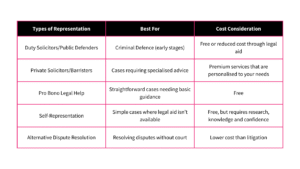
Navigating legal representation requires careful consideration of your case’s complexity, your financial capability, and the resources available to you.
Use the guide below to help determine your best course of action:
Legal Representation With Harry Suleman Solicitors
Understanding the types of court representation available in the UK can significantly empower individuals facing legal challenges.
Each option, from consulting duty solicitors at court to hiring private professionals like Harry Suleman Solicitors, caters to different needs and circumstances.
Get in touch with Harry Suleman Solicitors to experience personalised legal services with a focus on achieving the best outcomes for you.